L ' S A I L E AV E I N 2 0 3 6 . W H AT ? | AI, Artificial Intelligence, Innovation, Louisiana Economy, Meta Data Center, Richland Parish, SpaceX, Startups
1 Rob Gaudet's Blog I have a question No, thanks Let me know if you have any questions!
Louisiana is importing the wrong kind of leverage — and the fix starts in middle school Before We Start This is not a criticism of Louisiana, of the Governor, of Meta, of Amazon, or of anyone who worked to bring this investment here. I want to be unambiguous, because what follows contains numbers that look unflattering if you read them as an indictment. They aren't an indictment. They're a map. Louisiana is receiving the largest capital investment wave in its history. That's genuinely good, and the people who landed it deserve credit. But we've run this movie before. From 2014 to 2024, $90 billion arrived and household prosperity did not follow. We can respond three ways: pretend it didn't happen, cross our fingers, or understand the mechanics and build deliberately on top of them. The first two are how a state ends up in 2046 with world-class infrastructure and the same median income it had in 2010. This takes the third option. And it arrives somewhere I didn't expect when I started running the numbers: the most valuable thing Louisiana could do right now costs about $35 million a year and has nothing to do with data centers. Part One: The Number
1
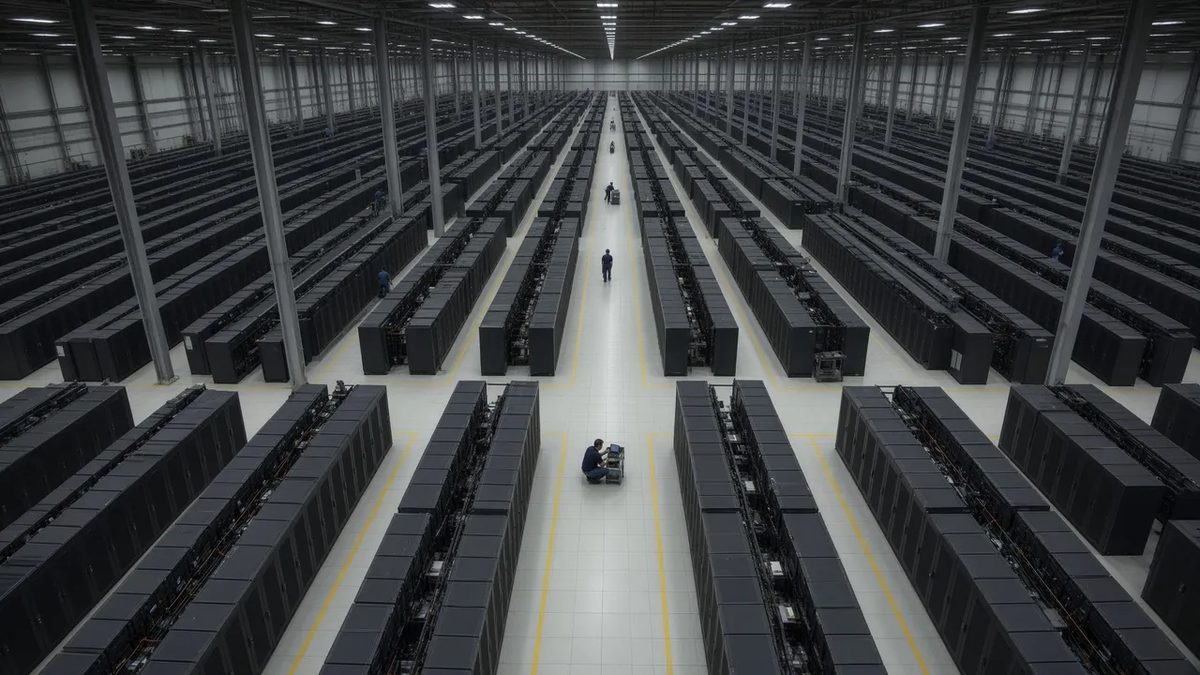
Here's every AI data center announced in Louisiana, with permanent job counts taken directly from Louisiana Economic Development or the companies themselves. Meta / Hyperion, Richland Parish — $50B — 1,000 permanent jobs — $50.0M per job Amazon / STACK, Caddo-Bossier — $18B — 750 permanent jobs — $24.0M per job Applied Digital / Delta Forge 1, Rapides — $3.6B — 200 permanent jobs — $18.0M per job Hut 8 / River Bend, West Feliciana — $10B — 75 permanent jobs (Phase I) — $133.3M per job TOTAL: $81.6 billion. 2,025 permanent jobs. $40.3 million of capital per permanent job. For comparison, traditional manufacturing creates a permanent job for every $500,000 to $2 million invested. Now the sentence that should stop you: Amazon's robotics fulfillment center in Shreveport, opened in 2024, employs over 2,000 people. One warehouse. Amazon's own number, Amazon's own facility, in the same state where Amazon is now building $18 billion of data centers. Louisiana's entire $81.6 billion AI buildout will employ roughly as many people as one Amazon warehouse. What $81.6 billion buys when it's spent building a company instead of a building Two thousand jobs sounds like a lot. It isn't — but you need a reference class to see that, so here's one. And to keep it fair, I'll use Amazon against Amazon. In 2018 Amazon chose Arlington, Virginia for HQ2. The commitment was $2.5 billion in capital investment and 25,000 jobs, at an average wage above $150,000, with a projected $3.2 billion in state tax revenue. That's $100,000 of capital per job. Louisiana's data centers run $40.3 million per job — a 403-fold difference. Now be maximally unfair to my own argument. Amazon is behind on HQ2. As of 2024 it had hired 7,232 people against a target it has since pushed to 2038, and downgraded its own confidence from "high" to "moderate." So let's use the underperformance as the benchmark: $2.5B ÷ 7,232 actually-hired = $345,686 per job. Even counting Amazon's failure to deliver, HQ2 is 117 times more job-efficient per dollar than Louisiana's data centers.
1
An independent check lands in the same place. A study of Stanford-affiliated startups found $65.9 billion raised across 1,676 companies; the venture-backed public companies from that cohort alone employ roughly 678,000 people. That's about $97,000 per job — within 3% of the HQ2 figure, from a completely different dataset and mechanism. So run the counterfactual. If Louisiana's $81.6 billion had been deployed the way capital gets deployed when the goal is building a company rather than building a facility: At the HQ2 committed rate ($100k/job): 816,000 jobs At the Stanford startup rate ($97k/job): 840,000 jobs At Amazon's actual underdelivering rate ($346k/job): 236,000 jobs Louisiana's total nonfarm employment is about 1,990,000. Even the most pessimistic version of that counterfactual — using Amazon's own failure as the model — would raise state employment by 12%. The optimistic version would raise it by 41%. Louisiana is getting 2,025. I want to be precise about what this does and doesn't prove. Nobody was going to hand Louisiana $81.6 billion in venture capital; that money exists specifically to build data centers, and refusing it would have produced zero jobs, not 816,000. This isn't a road not taken. It's a measurement of what kind of capital this is. Data center capital buys buildings. Company-building capital buys payrolls. Louisiana has become extraordinarily good at attracting the first kind and has built no mechanism whatsoever for generating the second. Which raises the obvious question: what would it take to generate the second kind here? That's the rest of this article. This isn't a flaw in the projects. It's the defining characteristic of the technology. A 5- gigawatt AI campus is a building full of machines engineered specifically to need very few humans. Complaining about that is like complaining that a fiber optic cable doesn't employ many people. The point is what it means for strategy: the direct jobs will never move Louisiana's numbers, so the strategy cannot be about direct jobs. Part Two: The Decade We Already Ran Before projecting forward, look at the control experiment. The Data Center's Pathways to Prosperity: Louisiana 2026, published this April, examined the last industrial wave. From 2014 to 2024, $90 billion flowed into Louisiana refineries, chemical plants, and LNG facilities.
1
U.S. employment grew 10.4%. Louisiana grew 0.18%. Median household income sits under $61,000, flat in real terms since 2010. The state lost 52,000 people. A family of four now needs two adults earning nearly $99,000 combined — up 19% in five years. Louisiana real estate values fell from 28th nationally in 2015 to third from the bottom by 2024. GDP peaked in 2023. Capital arrived. Prosperity did not. Capital investment and household prosperity are separate variables. Louisiana has proven it can attract the first. We have never built the machinery for the second. Part Three: The Frame That Explains Everything Naval Ravikant describes four kinds of leverage — four ways to get output that exceeds your own hours. 1. Labor — other people working for you. Oldest, hardest, requires permission. 2. Capital — money working for you. Powerful, requires permission. 3. Code — software working for you. Permissionless. Zero marginal cost to replicate. 4. Media — content working for you. Permissionless. Zero marginal cost to replicate. The last two are the ones that changed the world. You build once, it works while you sleep, and nobody has to grant you access. Now sort Louisiana's $150 billion: Meta, Amazon, Hut 8, Applied Digital — $81.6B — capital leverage, owned by someone else LNG export corridor — ~$40B — capital leverage, owned by someone else SpaceX spaceport — multi-billion — capital leverage, owned by someone else Construction workforce — 22,500 peak jobs — labor leverage, ends around 2036 Data center operations — 2,025 jobs — labor leverage Louisiana-owned software companies — code leverage — essentially none at scale Louisiana-owned media and IP — media leverage — essentially none at scale Every dollar of the $150 billion is capital leverage owned by somebody else. Every job it creates is labor leverage. Louisiana is importing the two forms of leverage that require permission and producing almost none of the two that don't. That is the whole problem, stated in one line.
1
We are extremely good at convincing outsiders to bring their capital here and hire some of our people. We have built nothing that lets a Louisianan create value while they sleep. Part Four: The Geography Won't Save Us Either I want to name a finding that cuts against something I believed when I started. Louisiana has an unusual hand. Hyperscale AI compute in four parishes. The nation's dominant LNG export capacity. An orbital launch facility coming to Vermilion. Deepwater ports. NASA heritage manufacturing at Michoud. No other state has that combination. I assumed colocation would generate substantial residual growth — the agglomeration effect, where related industries near each other share labor markets and spill knowledge across sector lines. Standard urban economics finds this is worth real money: an agglomeration elasticity of 0.02 to 0.10, which over twenty years could mean 15,000 to 45,000 additional jobs beyond the direct and indirect counts. Then I checked the drive times. Richland Parish to Vermilion Parish: 4.5 hours Caddo Parish to West Feliciana: 4 hours Rapides to Cameron: 3 hours Agglomeration requires assets close enough to share a labor market. These aren't. An engineer cannot work at the Meta campus and consult for the spaceport. A supplier cannot serve Shreveport and Boyce efficiently. A researcher at LSU cannot casually collaborate with someone in Richland Parish. Spreading the projects across every region was politically necessary — every parish got a win, every legislator got a ribbon-cutting. It was also economically self-defeating. We guaranteed that no single labor market reaches the density where clustering ignites. Louisiana's geography is currently a narrative asset. It is not yet an economic one. The map looks like a cluster and functions like seven islands. Part Five: 1986 I need to stop the analysis and tell you why I care about this more than any number above. In 1986 I took a computer programming class in high school. I was really good at it. That one class convinced me — completely — that I could write software. That was the same year Revenge of the Nerds came out.
1
I looked at what I was apparently signing up for and I couldn't see myself in it. Pocket protector. Taped glasses. The punchline of somebody else's movie. And beyond the image problem was a more practical question I had no answer to: what exactly was I going to do as a programmer in Lafayette in 1987? I graduated. I didn't pursue it. It took until 1993, in Baton Rouge, before I bought my first computer — from Cajun Computers, corner of Florida Boulevard and Airline Highway. I signed up with an internet provider called GNN, Global Network Navigator, and started building websites at night after my day job. Within two years I was a full-time software engineer. That was thirty years ago and I've never looked back. Here's what I know from the inside: The capability was there in 1986. What was missing was identity and a destination. I had the aptitude. What I didn't have was a picture of myself as someone who does this, or any visible path where doing it in Louisiana led anywhere. I lost seven years to that gap. Seven years, from a kid who was good at it on day one. Multiply that by every capable kid in every Louisiana high school for the last four decades. That's the real cost of what we've been doing — not the abatements, not the multipliers. Thousands of Louisiana kids who never found out they were capable, and who couldn't see a destination even when they suspected it. Part Six: The Thesis Everything above is setup. This is the argument. Louisiana's economic problem is not a jobs problem. It's a founder problem. And founders are made in adolescence, not in business school. Three claims, in order. Claim one: identity forms before college, and it's nearly permanent Nobody decides at twenty-two to become the kind of person who builds things. By twenty-two you already know whether you're "a math person" or "a creative" or "not technical." Those categories get installed somewhere around thirteen to sixteen and then they run your life.
1
I know this because I watched it happen to me in reverse. One semester in 1986 installed "I can write software." Then the culture installed "but that's not who I am" and it took seven years and a lot of luck to overwrite the second. The intervention that matters is not a college scholarship. It's making sure a fourteen- year-old experiences being good at building something, early enough that it becomes part of who they are rather than a subject they took. Every other lever — university capacity, workforce training, recruitment incentives — operates downstream of an identity that either formed or didn't, years earlier. And there's a competitor for that slot that Louisiana refuses to look at directly. An aside I'm going to make somebody mad with The scarce resource in adolescence isn't talent. It's deep focus — the hours a kid will voluntarily disappear into something, obsess over it, and get remarkable at it. Every kid has a limited supply of that, and it gets allocated early. In Louisiana, we allocate it almost entirely to sports. Here are the NCAA's own numbers. Of about 1,028,761 high school football players nationally, 259 get drafted into the NFL — 0.025%, or one in 3,972. Men's basketball is one in 11,683. Across football, basketball, and baseball combined, 99.96% of high school players never get drafted. Now hold that next to the thing nobody says out loud: code and media demand exactly the same capacity that makes an athlete remarkable. The same voluntary obsession, the same tolerance for repetition, the same willingness to be bad at something in public for two years before getting good. A kid running 5 a.m. two-a-days has already proven he has the machine. It has simply been pointed at a lottery ticket, by adults who love him and mean well. We celebrate the parent driving four hours to a select tournament. We call the kid building things at 2 a.m. antisocial. Under the model in Part Seven, a Louisiana kid's odds of founding a scalable company come out around 0.62% — roughly 24 times better than their odds of being drafted into the NFL. And unlike the draft, it doesn't require being born with the genes. I'm not arguing against sports. I'm arguing that Louisiana has spent generations perfecting a pipeline that turns childhood obsession into excellence, and pointed it at the one outcome with the worst odds available. We already know how to build the machine. We're just running it on the wrong fuel. That argument deserves its own post, and it's coming. This one is about what we'd point that focus at instead.
1
Claim two: code and storytelling have to be taught together This is the part almost every "teach kids to code" program gets wrong. Code alone produces employees. A kid who can build but can't find a customer, tell a story about what they made, price it, or reach an audience will get a job at somebody else's company — probably in Austin or Atlanta. Code plus media produces founders. Because those are exactly Naval's two permissionless leverages, and a person who has both can create value entirely on their own. Build the thing, tell the story, find the audience, no permission required. Look at the proof case, which happens to come from Kenner: Kevin Lin co-founded Twitch with a degree in ecology and evolutionary biology. He describes himself as flatly non-technical. What he had was narrative and market judgment — the ability to see what a platform could become and tell a story compelling enough to build partnerships around it. He rode that to roughly 90% market share and a $970 million acquisition. Now imagine a Louisiana kid who has both halves. That's not a workforce input. That's a company. Storytelling is also the half Louisiana is uniquely equipped to teach. This is the most narratively fluent state in America. We have more story per square mile than anywhere in the country. We have never once thought of that as an economic asset. Claim three: they need a visible destination This is the one the $150 billion finally answers. In 1987 I couldn't picture what a programmer did in Lafayette. In 2026 the answer is genuinely extraordinary — you work on the physical layer of artificial intelligence, forty minutes from where you grew up, in a state with more AI compute per capita than almost anywhere on earth. Almost no Louisiana fifteen-year-old knows this is happening or that it has anything to do with them. That's a communications failure, and it's free to fix. Part Seven: The Founder Funnel, Modeled Louisiana graduates roughly 45,000 high school students a year across about 350 high schools. Here's what happens to them now, and what could. Today (estimated):
1
45,000 graduates ~12% take any real CS or build course → 5,400 ~15% of those form an "I can build" identity → 810 ~30% persist into a technical path → 243 ~4% ever start a scalable business → ~10 founders per year Ten. Out of a graduating class of forty-five thousand. With universal code + storytelling + go-to-market: 45,000 graduates ~95% take a build-and-ship course → 42,750 ~16% form the identity → 6,840 ~45% persist → 3,078 ~9% found something scalable → ~277 founders per year Because I'd rather you have a defensible floor than a dramatic ceiling, here's the sensitivity: Today — ~10 founders/yr — ~435 jobs by year 20 Conservative (partial rollout, modest lift) — ~73 founders/yr — 3,260 jobs — 7.5x Moderate (most schools, real curriculum) — ~151 founders/yr — 6,774 jobs — 15.6x Full (universal, all three components) — ~277 founders/yr — 12,410 jobs — 28.5x At the full rollout, companies compound: ~1,550 operating companies and roughly 12,400 direct jobs by 2046 — about 29,800 with multiplier. Against 2,025 from $81.6 billion. Part Eight: What It Costs One specialized instructor per high school: 350 × $85,000 = $29.8M Equipment, software, curriculum: 350 × $15,000 = $5.2M Total: $35 million per year Louisiana currently forgoes roughly $2.7 billion per year in abated industrial property tax. (At 15% assessment and 120 mills on a $150 billion capital base — a range that brackets the published $21 billion estimate for LNG abatements alone.) This program costs 1.3% of what Louisiana already gives away annually. Cost per job created, twenty-year horizon: Code + storytelling program, conservative case: ~$215,000 per job AI data center buildout: $40,300,000 of capital per job
1
Even measured conservatively, teaching Louisiana kids to build and tell stories is roughly 188 times more efficient per job than the strategy the state is currently organized around. And there's a difference that doesn't show up in the per-job math at all: when Meta creates a job, Meta owns the asset and the upside. When a Louisiana kid starts a company, Louisianans own the equity — which means exits recycle back into the state as angel capital instead of leaving. Part Nine: The Bridge — Turning Their Machines Into Our Leverage The data centers aren't the prize. They're the raw material. Here's how the two strategies compound. Louisiana has roughly 6.3 gigawatts of disclosed planned AI compute landing inside its borders — an electricity draw comparable to a city of four to five million people. The state has been negotiating for jobs, which Part One showed is a losing proposition. It should be negotiating for compute access. 0.5% research set-aside — 32 MW — roughly $94M/year in compute value 1.0% set-aside — 63 MW — roughly $189M/year 2.0% set-aside — 126 MW — roughly $378M/year A 1% allocation would instantly make Louisiana one of the largest academic compute providers on earth. The NSF's entire national AI research resource pilot allocated a fraction of this. Cost to the state: zero. It's a term in a negotiation already underway. Now stack it: Compute (capital leverage, foreign-owned) → 1% research set-aside → Louisiana kids and researchers with frontier compute access → code + storytelling + go-to-market education → Louisiana-OWNED software and media companies (permissionless leverage) → exits recycle as local angel capital → self-funding ecosystem Every link in that chain exists today except the middle two. That is the entire gap. A seventeen-year-old in Ruston with access to 63 megawatts and the ability to build and tell a story is not a workforce statistic. That's the beginning of a company, and the company stays here. Part Ten: We Have Wins. They Need to Show Up.
1
Something I used to say myself: Louisiana has never produced tech wins. That was true. It stopped being true, and most people here haven't updated. David Filo, co-founder of Yahoo, grew up in Moss Bluff outside Lake Charles. Sam Houston High School, then computer engineering at Tulane in 1988 — one year after I graduated in Lafayette without pursuing the thing I was already good at. Same state, same era, opposite outcomes. Kevin Lin, co-founder and longtime COO of Twitch, was born in New Orleans in 1982 and raised in Metairie and Kenner. He took Twitch from nothing to roughly 90% market share, 2,000-plus employees, and $1.5 billion in revenue before Amazon bought it for about $970 million. And more recently than most Louisianans realize: Lucid — Patrick Comer — sold to Cint Group for $1.1 billion in 2021, New Orleans' first unicorn Levelset — Scott Wolfe Jr. — acquired by Procore for $500 million TurboSquid — Matt and Andy Wisdom — acquired by Shutterstock for $75 million Resilia — Sevetri Wilson, New Orleans native — over $50 million raised Eleven notable exits in the New Orleans ecosystem, per Startup Nola's database I started writing this section with a grievance and the research corrected me. Filo gave $30 million to Tulane's School of Engineering in 2005. Real and generous. But institutional philanthropy and ecosystem participation are different things — a check to an endowment doesn't put a founder in a room with a nineteen-year-old in Lafayette who just built something and doesn't know what to do next. Kevin Lin, though, is doing the harder version. He's described as a consistently deep patron of his hometowns of New Orleans and Taipei, he's an active angel investor, he co- founded Gold House, he's a general partner at an early-stage venture firm, and he's come back to New Orleans to speak at local innovation conferences. Lin is the model. He's proof that what I'm asking for is possible, because someone from Kenner is already doing it. So the argument isn't that no Louisiana founder gives back. It's that it runs entirely on individual conscience, and one person's generosity is not an ecosystem. Eleven exits. A Yahoo co-founder. A Twitch co-founder. A unicorn. If even half the people behind those outcomes participated at Lin's level — systematically, in public, with checkbooks and calendars — Louisiana would have a functioning founder network inside three years. The gap isn't generosity. It's structure and presence at scale.
1
And here's the specific ask that connects to everything above: the highest-value thing any of them could do isn't a scholarship. It's being visible to a fifteen-year-old. Filo's story should be taught in every Calcasieu Parish high school. Lin's in every Jefferson Parish high school. Not as trivia — as evidence that the path exists and starts here. Part Eleven: The Other Half of the Ledger Two things I'm not going to soft-pedal, because a strategy that ignores them will fail on its own terms. The ratepayer question. Entergy has requested approval for ten new gas plants plus solar and storage to serve the Meta site. Meta intends to pay for three new turbines, but $550 million in transmission costs is currently slated to pass to utility customers, and ratepayers could absorb remaining plant costs if Meta departs after its 15-year commitment. Amazon, by contrast, has committed to fully funding water, wastewater, and grid upgrades in the northwest, plus up to $400 million in water infrastructure. That difference should be standardized. Landry has said residents won't foot the bill; that needs enforcement mechanisms, not press conferences. The health question. Louisiana already leads the nation in cancer risk from toxic air pollution — over 41 residents per million at risk, 25% higher than Texas. Louisianans are 37% more likely to have COPD and 36% more likely to suffer a stroke than the national average. Data centers don't emit like refineries, but the gas generation serving them does. This matters directly to the thesis: engineers with options do not raise their kids in the highest cancer-risk air in America. The retention strategy and the environmental strategy are the same strategy. Part Twelve: What To Actually Do In order of leverage. 1. Universal build-and-ship in every Louisiana high school. $35M/year.Not an elective forty kids take. Every student, ninth or tenth grade, builds something real and ships it. The goal isn't to make everyone a programmer — it's to make sure no capable kid reaches graduation without discovering they're capable. 2. Teach storytelling as economic infrastructure, not enrichment.Positioning, audience, narrative, distribution. Paired with the code, in the same course, by design. This is the half that turns builders into founders, and it's the half Louisiana is best equipped to teach. 3. Add go-to-market engineering to every college engineering program.Customer discovery, pricing, distribution — alongside the technical curriculum, not as an MBA elective seven years later.
1
4. Negotiate a 1% compute set-aside. Costs nothing.63 megawatts of research access changes what a Louisiana education is worth and gives kids a ceiling that doesn't cap at facility maintenance. 5. Reform ITEP to a graduated structure and fund the rest from it.Deep exemptions for labor-intensive projects, shallow ones for $40-million-per-job facilities. Recruiting 500 senior AI researchers with $150,000 packages costs $75 million — 2.8% of one year's foregone revenue. The talent isn't expensive. The abatement is. 6. Pick one corridor and concentrate.Clusters become self-sustaining somewhere around 18,000 technical workers in one metro. Baton Rouge has roughly 4,500, New Orleans 6,200, Shreveport-Bossier 2,800 — all three, three to four times away. Given Part Four's finding, spreading effort guarantees none of them ignite. The Baton Rouge–West Feliciana corridor is the strongest candidate: LSU engineering, the Hut 8/Anthropic campus, the capitol, two hours from New Orleans. 7. Mandate supply-chain localization with escalating floors.Meta reports $1.6 billion contracted to Louisiana businesses. That should be a contractual floor with annual targets, not a press-release statistic. 8. Build a founder network with structure, not goodwill.A named commitment from every Louisiana-connected founder with an exit: office hours, pre-seed checks, and one high school visit a year. The Bottom Line Louisiana is receiving generational capital. Real, and worth celebrating. But capital is an input, not an outcome. We ran this from 2014 to 2024 with $90 billion and finished with flat employment, flat real income, and 52,000 fewer neighbors. The deeper problem is that we're playing for the wrong kind of leverage. Every dollar arriving is capital owned by someone else. Every job it makes is labor. We've built nothing that lets a Louisianan create something that works while they sleep — and code and media, the two leverages that require nobody's permission, are exactly what this state does not produce. That's fixable, and the fix is absurdly cheap. Thirty-five million dollars a year — 1.3% of what we already give away — to make sure every fourteen-year-old in Louisiana finds out they can build something and tell the world about it. In 1986 a kid in Lafayette found out he could write software and then talked himself out of it for seven years, because he couldn't see himself in it and couldn't see where it led. That kid was me, and I was one of the lucky ones. I found my way back in 1993 with a computer from a shop on Florida Boulevard and a dial-up account.
1
There are fifteen-year-olds in Ruston and Abbeville and New Orleans East right now who are exactly as capable as I was, sitting inside the largest technology buildout in this state's history, and most of them have no idea it's happening or that it has anything to do with them. That's the gap. Everything else is downstream of it. The $81 billion is coming either way. Whether Louisianans end up with 2,025 jobs and a tax bill, or a generation of people who own what they built, depends on whether we bother to tell our kids they're capable of building it. Sources and Method Job figures are taken directly from Louisiana Economic Development announcements or company statements: Meta and Turner Construction (1,000 operational roles, Richland Parish); LED (540 direct jobs February 2026 plus 210 in the August expansion = 750, Amazon/STACK); LED (200 direct full-time, Applied Digital Delta Forge 1); LED ("at least 75 direct new jobs," Hut 8 River Bend Phase I). Amazon's Shreveport fulfillment center headcount ("over 2,000") is Amazon's own figure. Counterfactual benchmark: Amazon HQ2 commitment figures from Amazon and the Virginia Economic Development Partnership ($2.5B, 25,000 jobs, average wage above $150,000); actual hiring (7,232 as of 2024) and the confidence downgrade from Virginia Business, April 2025, and Amazon's own state incentive filing. Startup cohort comparison from "Startups and Stanford University" (arXiv:1711.00644): $65.9B raised across 1,676 firms, 678,000 employed at the VC-backed public companies in that cohort. Baseline data: U.S. Bureau of Labor Statistics; FRED/St. Louis Fed; U.S. Census Bureau. Economic outcomes: The Data Center, Pathways to Prosperity: Louisiana 2026 (April 17, 2026). Athletics probability: NCAA Research, "Probability of Competing Beyond High School," 2024-25 figures, with high school participation from the National Federation of State High School Associations survey; HS-to-drafted percentages calculated by compounding the published HS-to-NCAA and NCAA-to-draft figures. Founder and exit data: Wikipedia, Encyclopedia.com, Gold House, INNO Conference, 886 Studios, the AIT Podcast, Biz New Orleans, Hypepotamus, Startup Nola, TechCrunch, Big Easy Magazine. Abatement reference: New Orleans CityBusiness, December 2024. Method notes: The leverage framework is Naval Ravikant's. Agglomeration elasticity range (0.02–0.10) is drawn from standard urban economics literature; drive times are approximate. Founder funnel rates are estimates, and the sensitivity table is provided because the full-rollout figure compounds four separate rate changes and should be read as a ceiling rather than a forecast. Company survival (35% at five years) and average headcount (8) are conservative small-business norms. Compute valuation uses $3.0M per MW-year. Cluster critical-mass threshold (~18,000 technical workers) is approximate.
1
Property tax figures assume 15% assessment at 120 mills. High school graduate and school counts are approximate. All projections are illustrative models, not forecasts. SpaceX figures are not incorporated pending the August 24 announcement.
Comments
No comments yet. Be the first.
Leave a comment